

How to Delete an L5P Duramax the Right Way: DPF, EGR & DEF
Here is a practical L5P Duramax delete guide for 2017-2026 Silverado HD and Sierra HD owners prepared by the Dieselino team. This L5P delete kit checklist covers the parts, tuning order, year differences, cost, and mistakes we see most often.

The short answer
A proper L5P delete is a full delete of the DPF, EGR, and DEF/SCR systems, but the tune comes first: the L5P’s E41 ECM must be unlocked or supported before the hardware is removed. For most 2017-2026 trucks, budget about $2,809-$5,566 before labor, depending on model year, exhaust choice, ECM path, and any 2020+ TCM support.
The L5P is one of the strongest factory Duramax engines, rated at 445 hp and 910 lb-ft for 2017-2023 trucks, then 470 hp and 975 lb-ft from 2024 onward. It is also heavily managed by emissions hardware and electronics. [3] When regen cycles, DEF faults, EGR cooler issues, or high-mileage maintenance start getting expensive, owners often look at L5P delete options.
The L5P delete process is more complex than an older LML or LBZ delete because tuning access, ECM support, and model-year differences decide the job. Below, we’ll cover what comes off, what gets tuned first, and what the full setup usually costs.
What does “delete” mean on an L5P Duramax?
A full L5P delete means removing or disabling the factory DPF, EGR, and DEF/SCR systems and loading an ECM tune that lets the truck run correctly without those emissions components. Hardware alone is not enough. Without the right tune, the truck can throw codes, derate power, or go into limp mode.
The L5P factory emissions stack includes cooled EGR, SCR, DPF, and related controls. An L5P DPF delete only addresses one part of that system. A pipe without the matching tune leaves the ECM looking for sensors and flow data that are no longer there.
- DPF: The diesel particulate filter traps soot, then burns it off during regen; short trips and towing cycles can make failures more common.
- EGR: An L5P EGR delete removes the exhaust-recirculation side from the setup, including parts tied to hot, sooty exhaust and common cooler failures.
- DEF/SCR: An L5P DEF delete removes the fluid, heaters, sensors, and NOx-monitoring side from the setup, which is why it is usually handled with tuning and the exhaust work.
In our experience, the buyers who have the least trouble are the ones who match the exhaust, EGR hardware, CAN plugs, and tune before touching the truck.

Why is an L5P delete harder than older Duramax deletes?
An L5P delete is harder than an older Duramax delete because the truck’s ECM is locked, and the emissions system is tied deeper into the control network. The job starts with the electronics: the L5P delete tuner, ECM unlock, credits, and tune file must be sorted before the DPF, EGR, or DEF hardware comes off.
On 2017-2023 trucks, the key piece is the E41 ECM. In the HP Tuners setup, that means using the MPVI interface, the correct credits, and either an OBDII upgrade path or a send-in/unlock route, depending on the truck year. If that step is missed, the truck may not accept the calibration needed to run without factory emissions hardware. [4]
CAN bus plugs are another L5P-specific detail that buyers sometimes underestimate. The truck still expects clean communication from parts of the emissions system. The plugs help keep the network stable after those components are unplugged or removed.
The 2020+ trucks add one more layer: the Allison 10L1000. When the engine tune changes torque delivery, the transmission control side may also need attention. A truck can run poorly if the engine calibration and TCM strategy are not planned together.
| Model years | ECM | TCM tune required | What you need | Note |
|---|---|---|---|---|
| 2017-2019 | E41 | Usually no | Unlock, tune, plugs | Early L5P |
| 2020-2023 | E41 | Check T93 | Unlock, tune, T93 | 10-speed trucks |
| 2024-2025 | Updated path | Confirm by VIN | Unlock, tune, kit | Verify before buying |
For 2024-2025 trucks, do not assume the same process as 2020-2023. Current solutions exist, but the unlock path, tuning support, and kit contents can change quickly. We recommend confirming the exact VIN, ECM support, and tune package before ordering.
What do you need for an L5P delete?
To delete an L5P properly, you need four elements: a supported ECM path, calibrated tuning, emissions-delete hardware, and the plugs/support parts that keep the truck communicating correctly.
- ECM unlock or supported ECM path. The truck must accept the new calibration. Without this step, the delete cannot be completed correctly.
- Tune file and credits. The tune tells the ECM how to run without the removed emissions systems. Hardware without the tune can trigger codes, derate warnings, or limp mode.
- DPF/CAT delete pipe or full exhaust. This core hardware piece replaces the restricted factory exhaust section. For this L5P delete kit part, confirm whether the truck needs only a delete pipe or a 4-inch/5-inch exhaust, then check muffler choice, hanger position, and clamp hardware before install.
- EGR delete hardware. In an L5P full delete kit, pipes, block-off plates, gaskets, and hardware close the EGR side instead of leaving open ports or leaks.
- CAN communication plugs. Install these after emissions connectors are unplugged so the network still sees the signals it needs.
- TCM support where needed. On 2020-2023 trucks, T93 planning may be needed so the engine tune and transmission strategy work together.
- Year-matched parts package. A Duramax delete kit should match the truck year, because the wrong setup can leave gaps in tuning, plugs, or fitment.
Our picks for the best L5P delete kit
Chosen by our install team
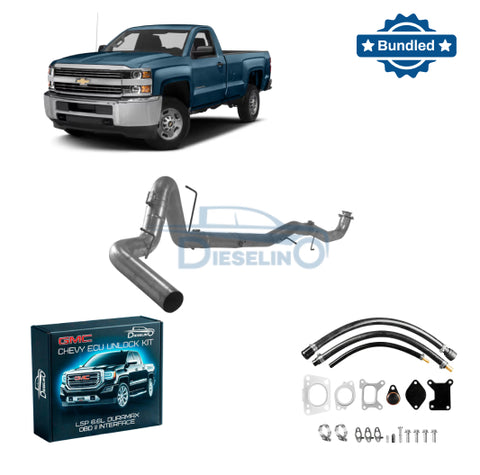
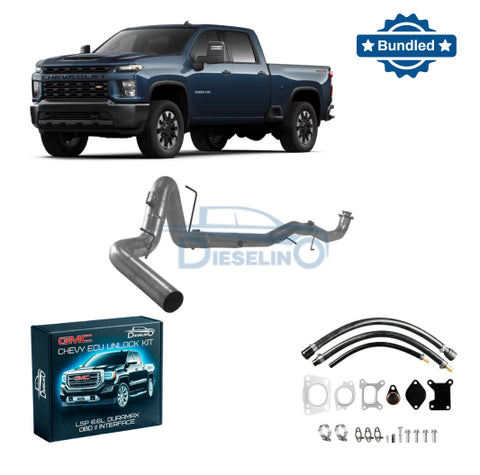
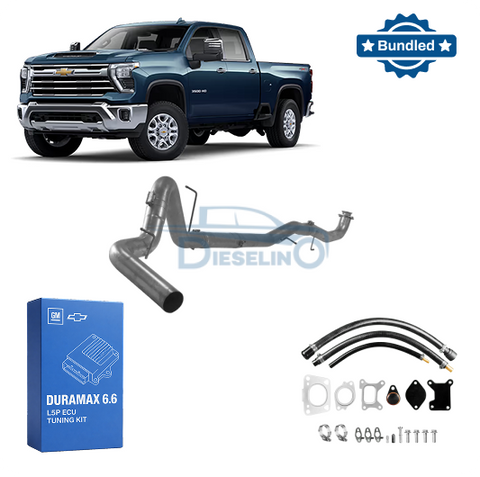
Pro tip
Before teardown, record the VIN, calibration ID, ECM service number, transmission, exhaust diameter, and sensor/plug locations. Confirm the ECM unlock route, tune file, credits, CAN plugs, EGR hardware, and exhaust layout against that list before any emissions components are unplugged.
How to delete L5P Duramax step by step?
It takes seven steps to delete an L5P Duramax correctly: confirm the truck, prepare the ECM, load the tune, install CAN plugs, remove factory emissions parts, fit the exhaust/EGR hardware, and scan the truck for codes. This approach keeps the install electronics-first and hardware-second, and it usually takes 8-12 hours for a careful DIY job in a home garage.
- Confirm the truck year and build. Start with the VIN, model year, and transmission, because 2017-2019, 2020-2023, and 2024-2025 trucks do not follow the same tuning path.
- Prepare the ECM. Complete the E41 unlock, upgrade, or supported ECM route before the truck is apart. This step decides whether the tune can be loaded cleanly.
- Load the tune before removing parts. The common mistake we see is pulling the DPF or EGR first, then trying to tune the truck afterward. That is how owners end up with codes, derate warnings, or limp mode before the install is finished.
- Install the CAN bus plugs. These small plugs keep communication stable after emissions-related components are unplugged. Missing one can turn the first start into a scan-tool session with avoidable communication codes.
- Fit the race pipe or exhaust. Remove the factory DPF/CAT section, then test-fit the L5P delete pipe or exhaust before final tightening. Check hanger position, clamp alignment, and clearance.
- Install the EGR delete hardware. Access is tight here, so plan for stuck fasteners and coolant cleanup. These L5P EGR delete instructions cover the order of work, not torque specs.
- Scan, start, and test. Clear stored codes, check for exhaust leaks, warm the truck fully, and confirm the tune behaves as expected before calling the job done.
Plan on sockets, extensions, penetrating oil, jack stands or lift access, clamps, a scan tool, and a clean laptop or handheld tuner setup.

Ready to build your L5P setup?
Shop an L5P full delete kit matched to your 2017-2026 Silverado or Sierra HD.
What are the real benefits of an L5P delete?
The real benefit of deleting an L5P is simpler maintenance, with power gains coming from the tune and freer exhaust flow. A full delete removes regen cycles, DEF-related faults, and common EGR cooler issues from the maintenance list.
- No regen cycles means fewer interruptions during towing, idling, or short-trip use.
- No DEF system means no DEF heaters, fluid quality sensors, or tank faults to chase.
- An L5P EGR delete keeps hot, sooty exhaust out of the intake path.
- A freer exhaust can reduce backpressure when paired with the right tune.
- SOTF-style tuning makes the truck easier to match to towing or off-road use.
The DPF alone is not where big horsepower comes from. When a deleted truck feels stronger, that is usually the tune, airflow, and torque management doing the work.
What are the risks of deleting an L5P?
The main L5P delete problems are legal exposure for on-road use, warranty issues, and resale limits.
- Warranty: GM or a dealer may challenge powertrain, emissions, or aftertreatment claims tied to the modification.
- Resale: Some buyers will avoid deleted trucks because they cannot use them legally on public roads.
- Trade-in: Dealers may reject the truck or price it lower if emissions hardware is missing.
- Diagnostics: A poor tune can make future troubleshooting harder than it needs to be.
The Magnuson-Moss Warranty Act does not let a company deny every warranty claim just because an aftermarket part exists. Still, that does not make an emissions delete harmless for warranty coverage. If the modification is tied to the failure, expect the claim to be challenged. [2]
So, is it worth doing? For an off-road, competition, or export truck with repeated emissions-system issues, it can make sense. For a daily driver that must pass inspections, keep warranty coverage, and stay road-legal, it is usually the wrong direction.
How much does it cost to delete a L5P Duramax?
The L5P delete cost starts at about $297-$385 for standalone EGR or DPF/CAT delete hardware, while L5P tuning-related pieces start from about $299 for TCM unlock tools and $1,367 for SOTF tune packages. Current full L5P delete kits are listed from $3,227 for 2017-2023 trucks and from $3,694 for 2024-2025 models, with final cost depending on model year, exhaust choice, muffler option, ECM path, and transmission support.
The exact cost may vary based on whether you are pricing a single part or a complete setup. A complete budget includes the ECM unlock, tune file, credits, CAN plugs, EGR hardware, exhaust parts, and any needed TCM work.
Current 2017-2019 and 2020-2023 full bundles put the L5P delete kit budget at $2,809-$4,097, with 4-inch and 5-inch T-409 exhaust or DPF delete pipe options, plus EGR/cooler delete hardware included. The 2024-2026 full kit currently runs $3,448-$5,566 because newer trucks use a different ECU unlock route and tuning hardware.
An L5P tune and delete kit for a 2020+ truck can cost more when the build needs T93 TCM work. Current unlocked T93 TCM options for 2020-2023 trucks run from $300 to $979, depending on option and credits.
| Parameter | Stock L5P | After full delete + tune |
|---|---|---|
| Regen cycles | Active | Removed |
| DEF costs | Ongoing | Removed |
| EGR cooler risk | Present | Reduced |
| EGT under load | Factory-managed | Tune-dependent |
| Road-legal status | Legal | Off-road only |
| Tune required | Factory | Required |
Key takeaways
- Tune the ECM before removing L5P emissions hardware from the truck.
- Confirm the VIN, ECM unlock path, exhaust option, and transmission type before ordering parts.
- Budget for the full setup: tune file, credits, CAN plugs, EGR hardware, and possible TCM support.
- Choose a full delete kit for L5P Duramax trucks by year, ECM path, and transmission.
4 sources
- 1. EPA, Clean Air Act tampering and defeat-device guidance. (US EPA)
- 2. FTC, Businessperson’s Guide to Federal Warranty Law and Magnuson-Moss overview. (Federal Trade Commission)
- 3. GM Authority, GM 6.6L L5P Duramax specs, emissions controls, and power ratings. (GM Authority)
- 4. HP Tuners, GM E41 ECM Services, and direct OBDII upgrade notes for L5P. (HP Tuners)
Frequently asked questions
How much horsepower does an L5P delete add?
An L5P delete by itself adds roughly 10-30 HP from reduced backpressure - the real gains come from the tune. On 2017-2023 trucks, SOTF tune packages offer five switchable power levels, while current 2024-2025 tuning runs a single calibration at stock power, with multi-tune support expected as calibrations are released.
Does deleting an L5P improve fuel economy (MPG)?
Yes. Most owners report a modest gain of about 1-3 mpg after a full delete and tune, mainly because the truck stops burning extra fuel for regen cycles. Results depend on tune level, gearing, and driving style, so treat mpg as a side benefit, not the reason to delete.
Will an L5P delete void my GM warranty?
Yes. It can affect coverage on emissions-related parts, so factor that in before deleting. The good news: the Magnuson-Moss Act protects you from blanket denials, and repairs unrelated to the delete are usually still covered. Claims the dealer ties directly to the modification, though, will likely be declined.
Do 2020-2023 L5P trucks need TCM tuning for a delete?
Not always. The delete itself is handled by the ECM tune. But 2020-2023 trucks run the Allison 10L1000, and stronger tunes change torque delivery faster than the stock TCM expects, so an unlocked T93 TCM is worth planning for to keep shifts smooth.
Matt Sullivan Verified expert
Diesel tech at Dieselino · 10+ years on Powerstroke, Cummins & Duramax
Deleting emissions equipment is not legal for vehicles driven on public roads in the US. These parts are sold for off-road, competition, and export use where allowed. Some states also inspect for tampering during registration or emissions checks, so confirm local rules before buying. [1]
Kits built with trusted tuning brands
Talk to a US-based diesel expert
Free fitment & build advice before you buy — no pressure, no bots.